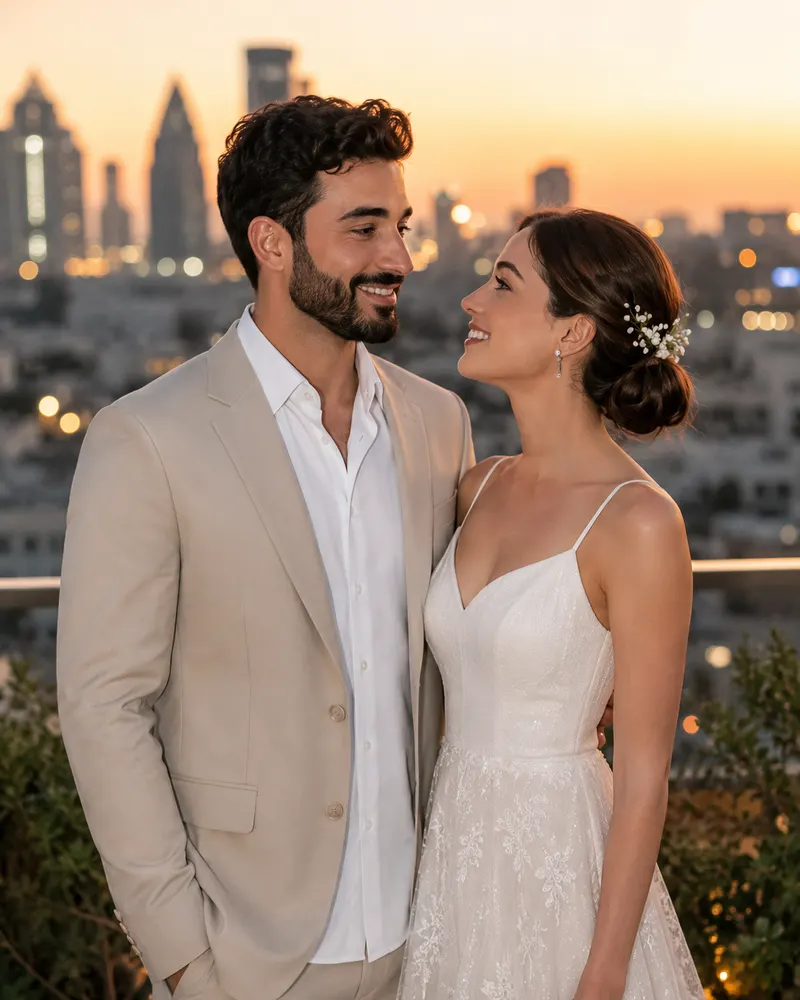
An Israeli wedding often brings together families from two cultures, guests flying in from abroad, and grandparents who grew up in another language. A bilingual invitation makes sure every guest understands exactly when, where, and how to RSVP — no guessing. This guide walks through when you need one, how to lay it out, and how to keep the design cohesive even when you mix writing directions.
When you need a bilingual invitation
Not every wedding needs two languages, but in some situations it’s almost essential:
- Mixed family — one side speaks Hebrew and the other speaks Russian, Arabic, or English.
- Guests from abroad — relatives or friends arriving from the US, Europe, or an Arabic-speaking country.
- An older generation — grandparents who immigrated and feel more at home in their mother tongue.
- An interfaith or intercultural wedding — where each side wants to see the invitation in its own language.
The rule is simple: if a guest won’t understand the details from the main invitation, they deserve a translation. It’s a matter of respect, not just convenience.
Three approaches to layout
There are three common ways to present two languages, and each fits a different situation:
- Two columns side by side — both languages on the same invitation, Hebrew on one side and the second language on the other. Keeps things unified and works when all guests see the same invitation.
- Two separate versions — a complete invitation in each language. Reads more cleanly, and lets you send each group of guests the right language over WhatsApp.
- A language toggle — in a digital invitation, a small button that switches languages on the same page. Especially elegant for three languages or more.
„We would love to celebrate with you — נשמח לחגוג איתכם” — one line speaking to both audiences, an example of how a double column can feel natural.
Names and dates: the details you can’t get wrong
This is where a small mistake shows the most. A name transliterated wrong or a date that doesn’t match across languages creates real confusion.
- Transliterating names — a name like „Chen” could be spelled Chen or Hen in English. Pick one version and keep it across the whole invitation.
- A consistent date — make sure the time is identical in every language; it’s easy to slip when re-typing.
- Order of names — sometimes the bride’s name comes first in Hebrew and the groom’s in English, or the reverse. Decide in advance.
- Confirm with family — send the transliteration to parents to check before final production.
Mixing right-to-left and left-to-right text
Hebrew and Arabic are written right-to-left; English and Russian left-to-right. When you mix them on the same invitation, alignment is the secret to a clean design:
- Align each block of text to its own language’s direction — Hebrew to the right, English to the left.
- In double columns, place Hebrew on the right and the Latin-script language on the left, following the natural reading flow.
- Keep clear spacing between columns so the eye doesn’t get confused.
- Numbers and dates are always written left-to-right, even inside Hebrew text.
Keeping one cohesive design
The biggest risk with a bilingual invitation is that it looks like two invitations glued together. To prevent that:
- Matching typography — pick a Hebrew font and a Latin font that sit well together in weight and character.
- One lead color — the same palette for both languages, without letting one „shout” louder than the other.
- Identical hierarchy — if the name is large in Hebrew, it’s the same relative size in the second language.
- Visual balance — both languages should get equal presence, so neither side feels secondary.
If you want to understand in depth how a digital invitation is built, read the complete guide to digital wedding invitations — it fills in the rest of the picture.
How much it costs and how the process works
Adding a second language is usually a small add-on to the base invitation price — typically a few hundred shekels extra, depending on whether it’s a double column, a separate version, or a digital language toggle. With a digital invitation there’s no double printing cost, so multiple languages are far cheaper than on a printed invitation.
We love these invitations — they tell the story of two families coming together. Pick the package that fits you, and we’ll build an invitation that speaks to every one of your guests in their own language.