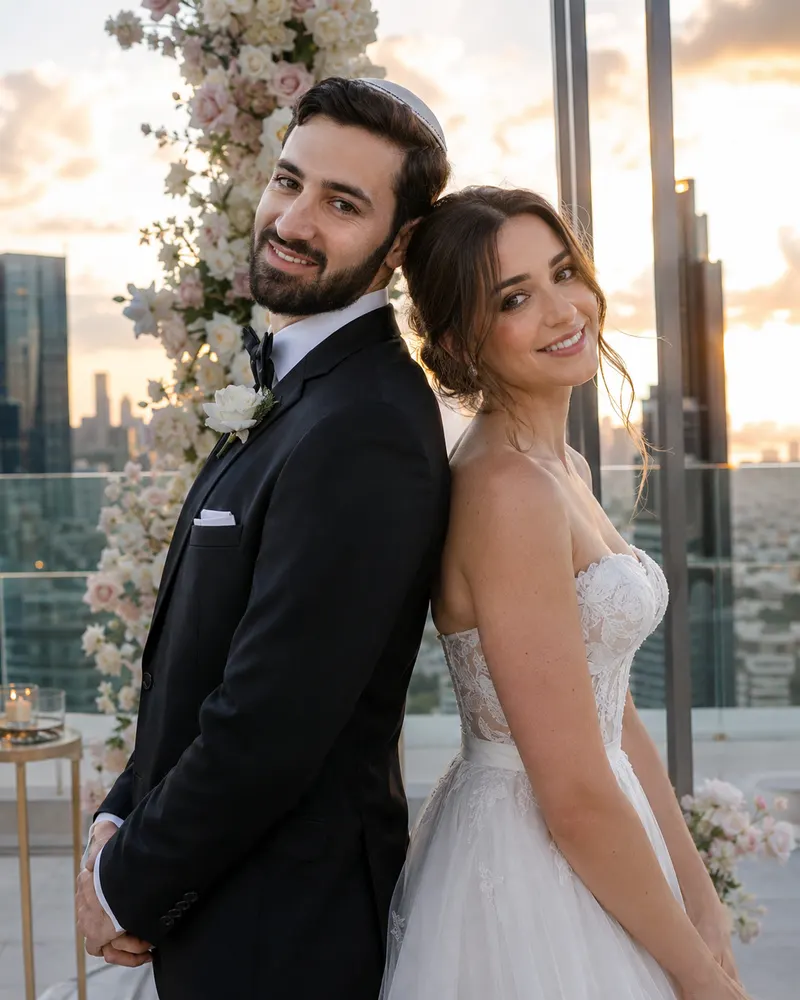
A Mizrahi or Sephardi wedding is, above all, a large, warm and joyfully loud family celebration, and the invitation should feel exactly that way from the very first glance. When one family joins another, the invitation no longer just announces a date; it declares the union of two households, two traditions and sometimes two languages. In this guide we walk through the aesthetic, the henna connection, the lines of honor for grandparents, and wording that respects every generation.
The aesthetic: warm, ornate and full of life
The classic Mizrahi-Sephardi invitation moves away from white minimalism. It loves color, texture and a feeling of festive richness. The elements that work best:
- A palette of gold, burgundy, bottle green or deep blue, often over a cream or ivory background.
- Arabesque frames, geometric lace and floral motifs that recall a rug or a copper plate.
- A decorative Hebrew or Latin font for the couple’s names, and a clean, readable font for the practical details.
- A subtle nod to the henna: a leaf, a hamsa hand or a red-and-gold ornament in the corner.
The secret is balance. Decorate the frame and the heading, and keep the event details clean and clear. If you want to understand how the digital invitation is built from start to RSVP, it is worth reading our complete guide to digital wedding invitations.
Family at the center: names, parents and grandparents
This is perhaps the biggest difference between a Mizrahi-Sephardi invitation and a modern secular one. Here the family is not in the margins; it is the headline. It is customary to include:
- The names of the groom’s and bride’s parents, often with the full surname.
- A blessing or mention of the grandparents, and sometimes a line in memory of a grandparent who has passed.
- Wording that emphasizes the shared joy of both families, not only the couple.
With joy and gratitude, the Elkabetz family and the Ben Hamo family are delighted to invite you to the wedding of our children, Ori and Noy. We would love to celebrate together on Tuesday, the 26th of May 2026, at the ‘Gan HaDekalim’ hall in Rishon LeZion.
The henna: a separate event worthy of its own invitation
The henna party is one of the warmest and most colorful moments before the wedding, and many couples give it a separate invitation. You can design the henna invitation in the same graphic style as the wedding one so they feel like a single set, just with a more red-and-gold palette and traditional motifs. If you are planning a henna, we have a dedicated henna ceremony invitation guide that explains the wording, the timing and the differences from the wedding invitation.
Points worth remembering:
- State clearly that this is the henna and not the wedding, so dates are not confused.
- Add a dress code if you are asking for traditional or colorful attire.
- Include Waze navigation to the home or venue, since the henna is often held in a less familiar place.
Lines of honor: French, Arabic and Ladino for grandparents
One of the most moving details in a Mizrahi-Sephardi invitation is a short line in the language of the older generation. Families from Morocco, Tunisia and Algeria often use French; Iraqi, Yemenite and Syrian communities often use Arabic; and some long-established Sephardi families also use Ladino. Here is how to do it beautifully:
- A single short line only, under the names or at the end, in a delicate font.
- A warm, natural phrasing, such as a personal invitation or a blessing, rather than a literal translation of the whole invitation.
- If the older generation reads only one language, consider a second version of the entire invitation in their language.
Avec joie, nous vous invitons au mariage de nos enfants — with great joy, we invite you to the wedding of our children.
A line like this makes the invitation personal and shows grandmother that she was thought of too.
Blessings and wording: between tradition and personal taste
The wording in a Mizrahi-Sephardi invitation tends to be warm and blessed, with an opening that thanks the Creator and blessings for the couple. Common phrases include “in a good and successful hour”, “with mazal tov” and “under a good sign”. Aim to balance the traditional blessing with the couple’s own tone, so the invitation feels authentic rather than rigid. If you are unsure how to bring it all together, read our guide to wedding invitation wording, which lays out structure, order and examples.
Why digital makes sense for a large family
In Mizrahi and Sephardi families the guest list is usually large, and digital simply works better:
- Real savings: printing and mailing invitations to the whole extended family can run into hundreds or thousands of shekels; a digital invitation costs a small fraction of that.
- Easy distribution over WhatsApp to family and group chats, including relatives abroad.
- A built-in RSVP that gathers confirmations in one place, Waze or Google Maps navigation, and one-tap add-to-calendar.
- Convenient gift payment through Bit or PayBox, which you can link directly from the invitation.
A digital invitation also lets you update a changed detail, such as a time or a hall number, without reprinting anything.
When you are ready, choose the package that fits you, and we at Tehila Sabag’s Paper of Love will continue with you over WhatsApp until the invitation feels exactly like your family. We would love to accompany you from the first design to the very last blessing.