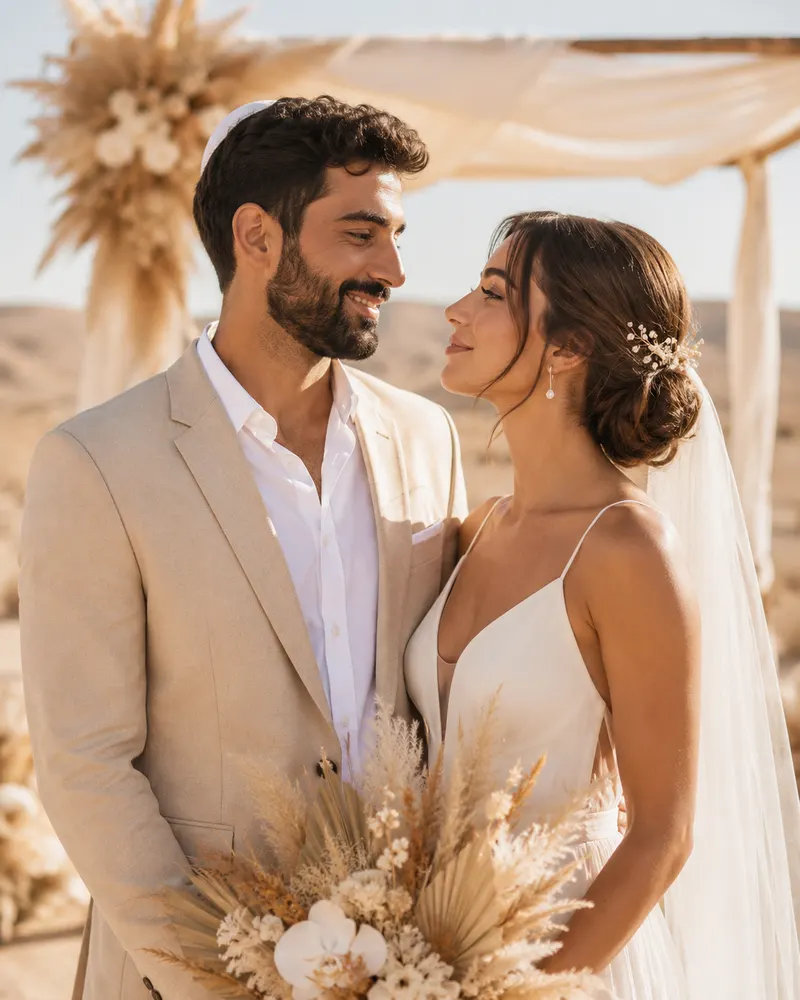

Every couple knows the moment: you close the list, count heads, and then the side questions begin. “Can I bring someone?”, “I added my partner too”, “Grandma asked if the kids are invited.” The plus-one is one of the most loaded topics in planning an Israeli wedding, because it touches both feelings and the budget. Smart wording up front saves awkwardness and hundreds of shekels in practice.
Who actually gets a plus-one
Before you write a single word, decide on your rule. In Israel the accepted norm is to grant a plus-one based on relationship, not on age or general marital status.
- Married, engaged, or cohabiting couples always get two seats, even if you only know one of them.
- Established partners you know by name deserve a seat too, even if they are not married.
- Single guests arriving at a wedding full of their own friends usually do not need a plus-one and can be seated at a warm, familiar table.
- Younger relatives coming solo are handled by acquaintance, not by a blanket “to be fair” rule.
The most important rule is consistency. If you gave a plus-one to one coworker, give it to the whole work group. Inconsistency is what creates hurt feelings, not the decision itself.
How to word it on the invitation
The digital invitation is your first tool for setting expectations. When it is addressed personally, the guest understands exactly what was offered.
- A couple’s invitation is phrased to honor both of them, for example “Yossi and Michal, we would love to see you.”
- A guest invited solo receives a singular invitation with no hint of an extra seat.
- When you want to allow a plus-one for a close single friend, you can phrase it gently in the message body.
Sample personal WhatsApp invitation: “Dear Noa, Yossi and Tehila are getting married on Thursday, June 19, 2026, at the Nof HaCarmel garden venue. We would love for you to come, and if you would like to bring someone, you are welcome. See you on the dance floor.”
This personal phrasing works far better than a generic blast, which is why it helps to build it using the full guide to digital wedding invitations that explains how to set expectations from the first line.
A digital RSVP that keeps you in control
This is where the real power lives. A digital RSVP with a pre-defined guest-count field is the simplest way to prevent unwanted plus-ones without a single awkward conversation.
- Set the maximum number of seats allotted to each guest so they cannot register more.
- Ask for the full name of the plus-one, not just a number, so you can seat people correctly.
- Add Waze or Google Maps navigation and an add-to-calendar option so those who confirm actually show up.
The numbers accumulating in the RSVP are exactly the foundation for managing your wedding guest list, so it pays to connect the two processes. If you want to go deeper on the technical side, the digital RSVP guide shows how to define smart fields that prevent mistakes before they happen.
How the plus-one hits your budget
This is not only courtesy, it is math. Every unplanned plus-one is another plate at the venue, and in Israel a plate usually runs 250 to 400 shekels, sometimes more at premium halls.
- Ten unexpected plus-ones can easily add 3,000 to 4,000 shekels to the final bill.
- Beyond food there is seating cost, alcohol, and sometimes an entire extra table.
- Without clear wording, guest assumptions quickly turn into a budget overrun.
The way to protect the numbers is not stinginess but clarity. When the guest knows exactly what was offered, they do not invent a plus-one, and you control the cost without sounding rigid.
When to be flexible
There are moments when bending the rule is right. If a guest added a plus-one you never invited and the budget still allows it, it is usually better to approve quietly than to create tension.
- For a close relative or dear friend, flexibility is worth more than the saving.
- When the budget gap is small, simply approve and move on.
- When the number truly overruns, reach out with a personal, gentle WhatsApp message and explain the venue is limited on seats.
Sample gentle message: “Hi Dana, so glad you confirmed! We would love to host you, just note the venue is limited on seats and we could hold one spot for you. We can’t wait to see you, and if anything changed, message me and we’ll sort it out.”
A gift sent through Bit or PayBox does not change the rule, but it is a small reminder that every guest also carries a financial value, so clarity serves everyone.
Once the rules and the wording are clear, the plus-one stops being a source of stress and becomes just another tidy detail of your evening. If you’d like us to build an invitation and RSVP that set expectations from the first line, pick the package that fits you and we’ll continue from there on WhatsApp, step by step until everything is ready.